
Lighting for Restaurant and Residential Dining
If you have been a reader of our blogs over the last 10 years – yes 10 years – then thank you for still being here! We’ve always tried our best to be consistent and topical.
This is the latest on my approach to lighting restaurants but it’s also applicable to a residential setting – on how to create the best atmosphere and ambience within a restaurant setting. In these strange times, it is an ideal opportunity to examine your lighting and interior offering and we are here to help.http://www.chameleondesignsinteriors.co.uk
The Importance of Light in a Restaurants Function
There are many styles of dining that broadly fit into two categories – those where the restaurateur wants you to linger, presumably to buy that extra bottle of wine, and the type that wants you to refuel quickly and leave satisfied. In other words, the interior feel ranges from the ambient through to functional, the convivial through to the routine. Lighting is the key factor in creating these settings across all restaurant interior design. Next to the menu, the lighting defines the customer experience and frames the concept of the establishment, with a hundred subtle differences to decipher, from the silver service to a relaxed bistro or champagne bar to corner cafe.
Successful Lighting for Restaurant/Home Dining
The Science of Ambience
A candle-lit glow is the very epitome of the fine dining setting. Have you ever wondered why a warm glow is so desirable and seems to create an atmosphere somewhere between convivial and romantic? A low, warm light tends to be favourable lighting for a lot of people in terms of enriching skin colour, and according to neuro-psychologists, there is a scientific link to why skin colour increases perceived attractiveness. It seems people with well-oxygenated blood appear to be more physically fit and represent a good match. A pallid skin has the opposite effect and indicates a weak immune system and hence a bad potential mate. These traits are so powerful that they override other customary signals.
Lighting Design Tip For Dining Spaces
Amid the ambience, it is important to remember to draw the eye through the flattening effect of a single tone of colour. Choose a focal point for a dining space. Often this is delivered by a physical feature within the room, or a statement light – such as a chandelier or row of table lights as a centre-piece.
Lighting Functionality Without Loosing Atmosphere
Modern Restaurant/Home Design: The Functional Aesthetic
Increasingly restaurants are becoming one space in a growing trend to make the kitchen and ‘the-pass’ visible to the diner. In new builds, this is the default with refurbishments increasingly featuring a view through to the chef. This underlines the real challenge of lighting a restaurant – the conflict between functional and ambient.
Lighting Control in a Restaurant/Home
In these multi-functional spaces, lighting needs to be flexible to cater for various activities. It is here that in many ways the designer faces their greatest challenge. Essentially, each lit area or ‘scene’ needs to be planned out meticulously. Smart controls offer a flexible dimension allowing controllability at the touch of a button from different locations, with all budgets including a recommended, if not essential, simple dimming system.
Given the variety of scenes, different types of lighting are needed within each space of the restaurant. Full brightness is needed for task activities such as food preparation, while daylight is more inline with the restaurant necessity of relaxation combined with decent downward lumen level to view food. The main purpose of this layered lighting scheme is to create a sociable ambient experience that illuminates the interior and its features. As the mood and natural light changes throughout the day, the evening service needs to intensify the ambience by decreasing the lumen outputs and relying upon chosen pockets of light to create an environment diners want to linger in.
Restaurant/Home Lighting Tips and Ideas
Building layers is the key here, so elements of the lighting scheme can be adapted to suit the scene.
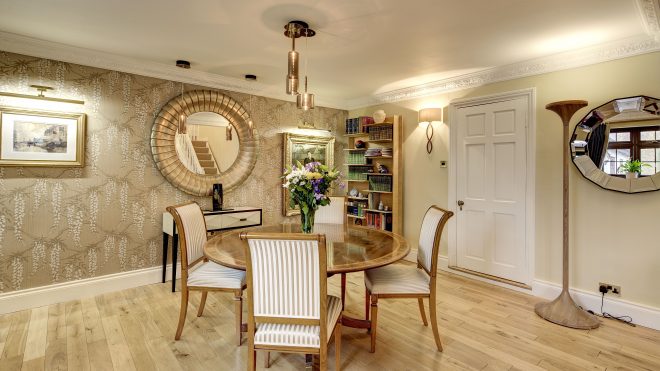
Position a decorative lamp as a strong focal point over the table to delineate the space.
Support the pendant light with down lights over the table surface to provide task lighting. Glass pendants or chandeliers often do not provide much light; supplementary lighting will give them sparkle and bring them to life.
Further to this, illuminating perimeter walls and surfaces provides a background ambient light to support the tabletop lighting and creates interest. Wash walls with light, use picture lights and wall lights, and light shelving in cabinets.
Importance of Planning Lighting Scene Settings
From the outset in the planning stage, ensure the provision of separate lighting circuits to modulate scenes.
Another key tip is to illuminate curtains – they look sorry for themselves at night when unlit! On a dimmable circuit, a colour washed curtain can appear like a tapestry, reflecting colour back into the space and providing another aspect of interest.
Lighting the outside also creates a scene through a window at night to provide interest and to extend the space into the garden, while breaking up the space into the garden, while breaking up the black coldness of a darkened windowpane.
Lighting Glare in Restaurants/Home
The conflict between the eye line of the diners and the functional lights required by the catering staff is a key consideration. Be careful to specify down lights with good anti-glare characteristics – many feature a light source that is positioned far back into the body of the light. Similarly use ‘snoots’ and louvered shutters on spotlights to direct the light in a single direction and avoid spilling the light into diner’s eyes.
To avoid human level lighting altogether, add some uplighters, either on the wall or from the floor to freshen the ceiling and bounce diffused light, which acts as a good background illumination. Don’t forget, table and counter top lights are a great addition and an easy way to provide a middle layer of light especially flexible when wired into their own 5amp circuit.
I love designing restaurant/Home lighting schemes – matching the interior designer’s vision is a real challenge, but the growing number of options in this LED era provides endless possibilities.http://www.chameleondesignsinteriors.co.uk
The simple trick whether you are designing a functional or ambient experience is to avoid conflict and build flexibility into the space.